Turns Out, "Figure It Out" Is Not a Leadership Strategy
Let's be honest. At some point in your university career, whether you're a student leader, dean, director, or faculty member, you’ve sat in a meeting, smiled politely, and thought: I have absolutely no idea how to handle this.
You're not alone. You're not even unusual. You are, in fact, a human being operating inside one of the most complex social ecosystems ever devised: a university campus. Thousands of people, wildly different priorities, enormous pressure, very strong opinions about everything. And somehow, everyone is expected to just “figure it out.”
And somehow, everyone is expected to just “figure it out.”
Congratulations, they trust you. Also: there's help.
Kimberly Goff-Crews, Vice President for University Life at Yale University, has spent years watching smart, capable leaders hit this wall, and also watching what happens when they're finally given tangible support. Her experience partnering with Human Better is a case study in what becomes possible when institutions stop assuming that well-intentioned people automatically become good leaders.
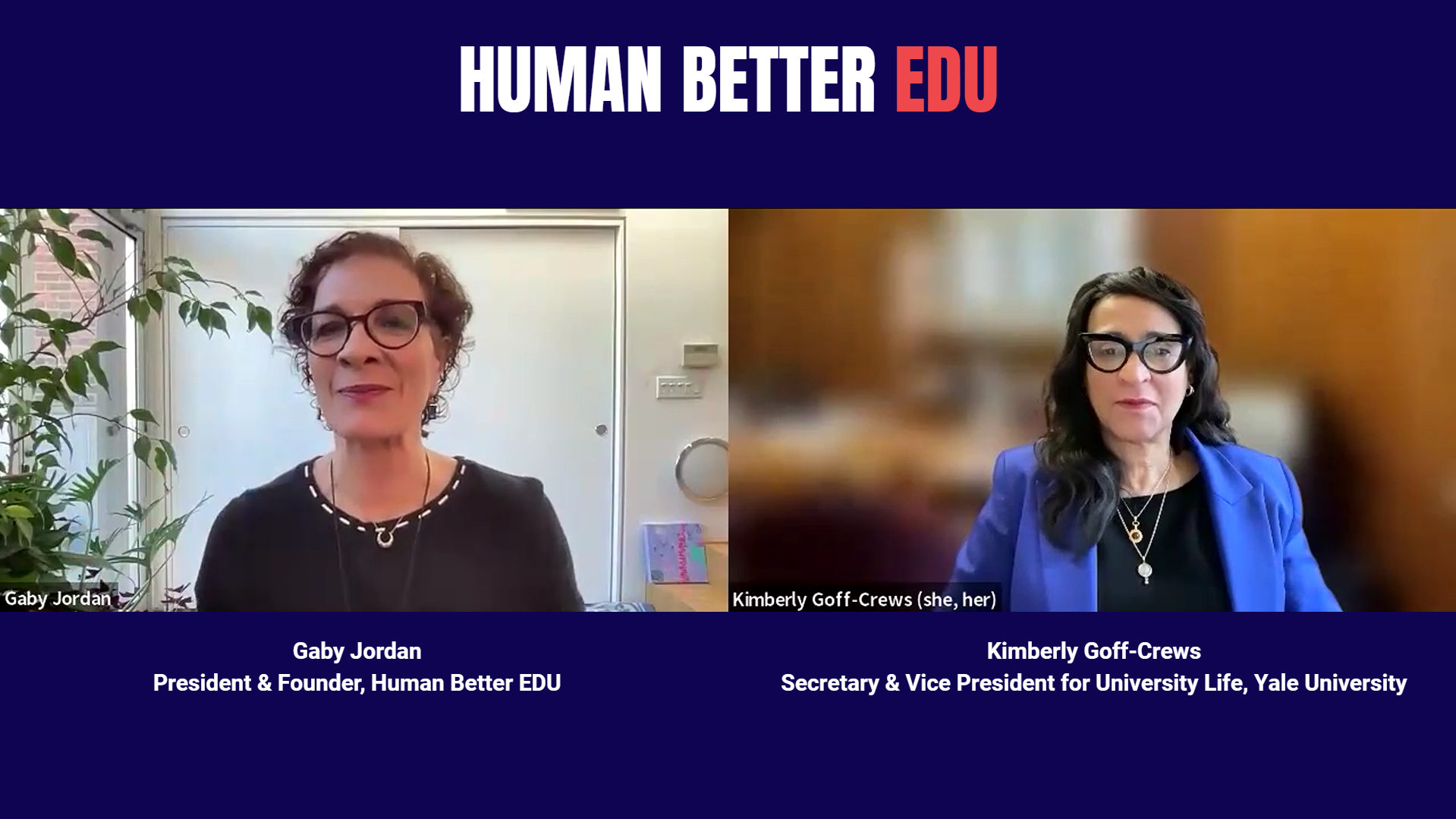
Human Better President & Founder, Gaby Jordan, interviews Kim Goff-Crews on her experience with Human Better life design programing at Yale University.
Great at school. New at this.
Picture a sophomore who just got elected president of a student organization with 800 members. Are they smart? Absolutely. Experienced in navigating conflict, competing agendas, and institutional complexity? Not exactly. As Goff-Crews paints, "They are experiencing, for the first time, how to lead across differences and how to lead in a really complex environment they might not quite understand."
"They are experiencing, for the first time, how to lead across differences and how to lead in a really complex environment they might not quite understand."
When Human Better EDU began coaching Yale students, something unexpected happened. Students came for leadership coaching, but quickly realized they also needed support navigating their futures, relationships, anxiety, and the growing uncertainty of modern life. They came for a workshop and left with, as Goff-Crews put it, "a sense of relief that there's a structure in which they could create their lives. That's something rarely taught in a classroom, but it's something we want our students to have."
Many of them signed up for more. Not because they were told to, but because they wanted to. If you're keeping score, that is a very good sign.
Your chiefs of staff called. They have questions too.
Here's the part most leadership programs skip. They focus on students, hand out a certificate, and call it a day. But universities don't run on students alone. They run on the chiefs of staff, directors, department heads, and mid-level administrators quietly managing seventeen emergencies before 9am.
universities don't run on students alone.
Goff-Crews intentionally brought Human Better coaches in to work one-on-one with high-potential staff she was developing into larger leadership roles. The response was immediate: they asked for a second year and she endorsed it because she witnessed the improvement. She explained, “They act with much more confidence. They are moving through their learning cycles much more quickly."
The adults shape the culture.
Here's a truth that sounds simple but has enormous implications: when the adults in a community are supported, everyone benefits.
When faculty, staff, and administrators are resourced and they've done the work to understand themselves, manage their reactions, and show up with intention, their connections with students become more authentic. Their work goes deeper. The whole ecosystem gets healthier.
That’s what makes the Human Better EDU model different. It’s not a one-off workshop or wellness initiative people forget about a week later. It's a whole-system upgrade. Because a university isn’t a collection of programs. It's a living, breathing network of complex humans, interacting and learning together. When you strengthen the ecosystem, everyone inside it thrives.
a university isn’t a collection of programs. It's a living, breathing network of complex humans, interacting and learning together. When you strengthen the ecosystem, everyone inside it thrives.
The things people won't say to their boss
You might be thinking: we have counselors, advisors, mentors, faculty who care. And you probably do. That's genuinely great. It's also not the same thing.
People will say things to an outside coach that they simply won't say to someone inside the institution. Not because those internal relationships aren't good. There is just a kind of psychological safety that only comes from working with someone who has no stake in your performance review.
The VP who still does her own homework
One of the most compelling things about Kimberly Goff-Crews isn't her title or her institutional reach. It's that she still invests in her own coaching. She is a senior leader at one of the most respected universities in the world, and she continues asking: Where are my blind spots? What am I missing? How do I get better?
Where are my blind spots? What am I missing? How do I get better?
She's developed concrete tools: a practice for processing criticism without spiraling (she calls it "mining the gold"), a habit of writing down intrusive thoughts so they stop floating around untethered, and a better relationship with the negative self-talk that shows up, uninvited, in high-stakes moments. Simple, practical tools that work.
At one point, her coach reflected back something she hadn’t fully seen herself:
“Three months ago this happened and you handled it differently. Do you recognize that you’ve grown?” When its leaders grow, the university grows too.
"Everyone should have this." (Their words, not ours.)
When Yale student leaders were asked about their Human Better EDU experience, their response wasn’t polite praise. It was simple: “Everyone should have this.”
"Everyone should have this."
Universities talk constantly about developing the whole student. Human Better EDU is one of the rare partners approaching that work holistically — by supporting not just students, but the entire ecosystem around them.
The campus that gets this right won't just have better leaders and a better culture. It'll have better humans. Which, honestly, is the whole point.
Let us be Your Institutional Solution
Human Better EDU partners with universities and colleges to provide leadership coaching for students, staff, and administrators. Programs are available for individual coaching, group cohorts, and institutional engagements.

Casey Seidenberg
is a Human Better EDU Program Leader and Executive Life Coach. She leads our popular Take Charge of Your Life course for Middle Schoolers and High Schoolers. She also works with graduate-level educators to Kindergarten teachers and everything in between. Email Casey at casey@humanbetteredu.org.